Workplace Debate / Career Strategy
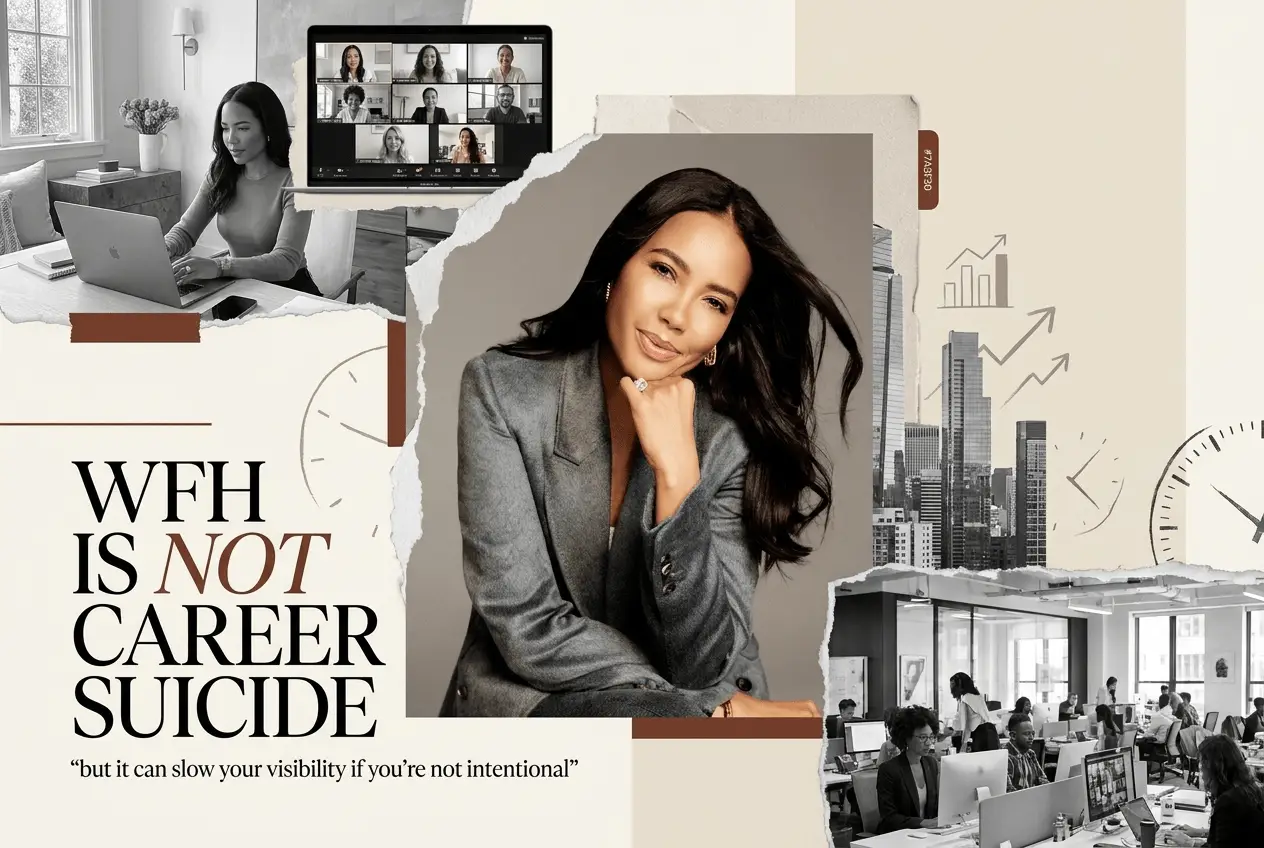
Emma Grede says WFH is career suicide. Is she right?
She is right that visibility moves careers. She is wrong that an office badge-swipe is the only way to build it. Here is the part of the argument that matters for Black women, plus a plan to protect your flexibility without disappearing from the promotion conversation.
01 The context
What Emma Grede actually said
Emma Grede, the CEO and co-founder of Good American and a founding partner of Skims, has repeated the same warning across interviews: ambitious women who work remotely risk losing the proximity and visibility that lead to raises, stretch assignments, and promotions.
Her bluntest version landed because it names a fear remote workers already carry. Are the people in the office building relationships you cannot see? Does a polished deliverable count less than the hallway conversation that happened after it? Is “flexibility” quietly moving your name to the bottom of the succession plan?
“Out of sight is out of mind.”
That line is not a law of work. It is a description of how many managers still operate. And that distinction matters: workers should understand the system they are in, but leaders do not get to call a biased system inevitable and walk away.
Read next / Office politics The Informal Org Chart: How Workplace Influence Works →02 The uncomfortable part
What she got right
Visibility is not vanity. Decision-makers cannot advocate for work they do not understand, and a spreadsheet of completed tasks rarely shows how you handled ambiguity, influenced a difficult room, or steadied a project when it went sideways. That texture builds trust.
Early-career employees are especially vulnerable. You are still learning which questions matter, who has power, and how decisions really get made. Some of that knowledge is documented. Much of it is transferred through observation, informal feedback, and being present when the conversation changes direction.
If nobody with influence can explain your impact when you are absent, your work is not visible enough, whether you sit at home or five desks away.
Grede is also right that women can absorb the hidden labor of remote work. “You are home” can quickly become “you can do pickup, answer the door, schedule the appointment, and still hit the deadline.” That is not flexibility. It is two jobs occupying the same hours.
Build the missing relationship Why High Performers Don’t Get Promoted →03 The gap
Where the argument breaks
The evidence does not support treating hybrid work as automatic career damage. In a randomized trial of 1,612 employees at Trip.com, working from home two days a week improved satisfaction, cut attrition by one-third, and produced no evidence of worse performance reviews or promotions over two years.
There is still a gender warning worth watching. The 2025 Women in the Workplace report found that women working remotely three or more days a week were less likely to report a recent promotion than men with the same arrangement. That does not prove remote work caused the gap. It shows that flexibility can sit inside the same gendered systems that already distribute opportunity unevenly.
And the office is not a neutral career laboratory for Black women. Pew found that 41% of Black workers said they had experienced race-based discrimination or unfair treatment in hiring, pay, or promotions. The same room that offers proximity can also demand code-switching, expose you to microaggressions, and consume energy that never appears on a performance review.
A five-day mandate also assumes access to dependable childcare, affordable housing near the office, a body that tolerates commuting, and a workplace worth being present in. Grede can be honest about what built her career without making her resources universal.
More workplace strategy Career Desk: Practical Workplace Advice for Black Women →04 Make it personal
Your career stage changes the math
There is no universally correct number of office days. Start with the leverage you have, the learning you need, and the moments where proximity changes the outcome.
Go in with a purpose.
Choose days when your manager, potential sponsors, and collaborators are present. Optimize for learning and relationships, not attendance.
Fix the high-performer trap →Trade a track record for choice.
Anchor office time to planning cycles, executive reviews, conflict, and decisions. Let focused work happen where it happens best.
Use assertive language →Make visibility fair.
Judge outcomes, distribute access, and sponsor people whose work you see less often. Your leadership defines whose flexibility is safe.
Build a promotion path →| Work moment | Best default | Why |
|---|---|---|
| Deep analysis or writing | Remote | Protect focus and produce an artifact people can see and share. |
| Kickoff, conflict, or decision | In person when possible | Read the room, build trust, and reduce ambiguity quickly. |
| Executive exposure | In person or camera-on | Connect your face, judgment, and point of view to the result. |
| Routine status work | Remote or async | Do not commute for a meeting that should have been an update. |
| Coaching and sponsorship | Deliberately mixed | Use live time for candor; use written updates to make impact portable. |
05 The practical plan
Build visibility that travels without you
The goal is not to perform busyness. It is to make your results, judgment, relationships, and next-level readiness legible to the people who make decisions. Start with these five moves. Your selections save on this device so you can come back to the plan.
Your WFH visibility plan
Choose the moves you will complete this month. A small system beats a dramatic return-to-office promise you cannot sustain.
If your organization cannot explain how remote employees earn visibility, advancement, and sponsorship, that is not a personal-brand problem. It is management information. Use it to decide whether to negotiate, escalate, or take your track record somewhere that knows how to evaluate it.
Turn the plan into action How to advocate for yourself and find a sponsor, with scripts included →06 Copy / paste
Three scripts for the conversation
Do not ask whether people “feel” you are visible. Ask for observable expectations, the moments that matter, and the evidence required for the next level.
“I want to make sure my hybrid schedule is not creating an information gap. Which rooms, relationships, and outcomes matter most for the next level? Where would my presence materially change the outcome?”
“Quick visibility update: we completed [work], which moved [business result] by [number]. The next decision is [decision], and my recommendation is [point of view].”
“I am working toward [next role]. Based on what you have seen, what proof would make you confident recommending me when that opportunity is discussed?”
07 The verdict
Take the strategy. Leave the shame.
Grede's career was built through proximity, and her warning contains a real structural truth: careers need relationships, context, and advocacy. But a personal success pattern is not universal evidence. Hybrid work can work. Remote work can work. The deciding factor is whether your organization knows how to see contribution without confusing presence for performance. It also depends on whether you make your value easy to carry into rooms you are not in.
The five things to remember
- Visibility matters. Build it around outcomes and relationships, not performative attendance.
- The office is not neutral. Proximity has benefits and costs; both belong in your calculation.
- Presence should be strategic. Go in for moments that change trust, learning, or decisions.
- Flexibility is not a favor. It is a work design that should have clear advancement rules.
- Your value needs a carrier. Results, receipts, and sponsors keep your name moving when you are not in the room.
If “face time” is the only path to advancement where you work, decide with clear eyes. You can play that game for a season, negotiate a smarter version, or find a company whose management systems have caught up with the work itself. That choice is career strategy, not career suicide.
08 Receipts
Sources and further reading
- 01 Inc., “Emma Grede Says Remote Work Is Quietly Sabotaging Careers,” March 15, 2026.
- 02 Nature, “Hybrid working from home improves retention without damaging performance,” June 12, 2024.
- 03 McKinsey & Company and LeanIn.Org, Women in the Workplace 2025.
- 04 Pew Research Center, “Black workers' views and experiences in the U.S. labor force stand out in key ways,” August 31, 2023.
Keep reading
Your next career move
Mentor vs. Sponsor: Why Black Women Need Both
Mentors advise you. Sponsors use their influence when you are not in the room.
8 min read → PromotionWhy High Performers Don't Get Promoted
Great work is the entry price. Here is what actually changes your trajectory.
Read the guide → Pay gapMy Coworkers Make More Than Me. Now What?
What to do in the next 48 hours, what to document, and exactly what to say.
10 min read →