
How to balance workouts and natural hair during the workweek
You do not have to choose between the body you are building and the crown you are protecting. The problem is almost never the sweat — it is a wash day scheduled on the wrong night. Here is the system: styles that survive five days, a scalp-first rinse routine, and a cadence that keeps Monday's hair intact through Friday's meeting.
In this article
Seven sections. Start wherever your week is breaking.
Start here
Sweat is salt. It is not dirt.
Most workweek hair damage does not come from working out. It comes from over-correcting for it — shampooing five times a week, retwisting every night, or skipping the workout entirely because Thursday's presentation matters more than Thursday's run.
Here is what is actually happening. Sweat leaves salt behind on the hair shaft, so strands that felt moisturized at 7 a.m. read dry and rough by lunch. Friction from a headband, a helmet, a hood or a too-tight ponytail concentrates tension on the same edges every single session. And sweat sitting on the scalp for hours — especially under a wig, a cap or a bonnet worn straight through the day — creates the warm, damp conditions behind itch, flaking and buildup.
Notice that only one of those three problems is solved by shampoo. The other two are solved by how you secure your hair before the workout and how fast you dry your scalp after it. That is the whole strategy: treat the scalp like skin and the hair like fabric. Skin needs rinsing and air. Fabric needs to be handled less.
The reframe
Stop asking “how do I wash my hair after every workout?” Start asking “what style can absorb four workouts and one wash day?” One question creates a nightly chore. The other creates a week you can actually run.
The plan
Build the week around one wash day, not five rescues.
Pick your wash day first. Everything else — cardio days, lifting days, the day you have the meeting where you want your hair exactly as you styled it — arranges itself around that anchor. This is the version that works for a three-to-five-workout week and a Monday-to-Friday office.
| Day | Workout | Hair move | Why |
|---|---|---|---|
| Sunday | Rest or a walk | Full wash day: cleanse, condition, style into the week's shape | You style once, with time, while nothing is on the calendar |
| Monday | Lift or strength | Nothing. Secure the roots and keep the style | Low sweat, low friction — freshest hair meets your lightest hair day |
| Tuesday | Cardio, high sweat | Scalp rinse at the sink; blot, then air-dry | Salt comes off the scalp without re-wetting the whole style |
| Wednesday | Yoga, pilates, mobility | Refresh: water-and-leave-in mist mid-shaft, oil on the ends | Midweek is where dryness shows — moisture, not cleansing |
| Thursday | Cardio or class | Co-wash or cleansing conditioner only, at night | Clears buildup without stripping; dries overnight |
| Friday | Rest, or evening only | Style day. Bun, puff, or take the twists down | Put your best hair on the day people see you most |
| Saturday | Longest workout | Sweat freely. Pre-poo that night if you deep-condition | The heaviest session sits right before the wash |
If you train in the morning, shift the rinse and the co-wash to the night before rather than the morning after — wet roots and a 9 a.m. commute are how edges get thin. If you train at night, you already have the better setup: rinse, blot, sleep on satin, and let the drying happen while you do.
Before the workout
Four minutes now saves an hour later.
All of this happens before you leave the house, and none of it needs product you do not already own.
Part it away from the sweat line
Sweat runs crown to nape and along the hairline. Two or four loose sections — flat twists, chunky braids, a pineapple — keep hair off the neck and stop wet strands from matting into each other while you move.
Put cotton or microfiber at the hairline
A wide band catches sweat before it reaches your edges — satin-lined inside, absorbent outside is ideal. Never a thin elastic on the same spot daily; that is friction with a schedule.
Light oil on the ends, nothing heavy on the scalp
A sealant on the mid-shaft and ends slows the moisture loss sweat accelerates. Keep butters and heavy grease off the scalp beforehand — they trap sweat instead of letting it evaporate.
Secure at the roots, not at the tension point
Use a spiral coil or fabric scrunchie, tie once, and move the placement each session. If you feel it in the first mile it is too tight — that is traction, the one workout hair problem that does not reverse on its own.
After the workout
Dry the scalp first. Decide about washing second.
The highest-value ten seconds in this whole article: get your scalp dry, or at least airy, within the first half hour. Band off, hair down out of the tight tie, air at the roots — in the locker room, in the car, at your desk if you have to. Then use this path.
Sweat at the hairline only, style intact
Blot with a microfiber towel, mist the hairline with water, smooth with a fingertip of leave-in. Do not touch the rest.
Scalp is wet, hair still looks styled
Scalp rinse at the sink: water on the roots only, lean forward, press the water out, air-dry. No product, no shampoo, no full re-wet.
Itchy, tender, or heavy with product
Co-wash or cleansing conditioner tonight. Itch is the signal that buildup, not sweat, is the problem.
Third or fourth sweat session since wash day
Full wash. Gentle sulfate-free shampoo on the scalp, conditioner on the hair, deep-condition if you have the twenty minutes.
Never: a bonnet or wig over a wet scalp
Damp and covered for eight hours is how odor, flaking and fungal irritation start. Air first, cover after.

The bag
Nine things live in the gym bag. Permanently.
Every pick below is a well-reviewed staple in the natural hair community — nothing exotic, nothing you have to reorder monthly. Buy once, leave it in the bag, and stop rebuilding your kit every Sunday night.
Some links may earn us a small commission at no cost to you. We only list what we would pack ourselves.
Swimming or cycling? Two more, and they are not optional.
Style survival
Ranked by how many sweat sessions they absorb.
Choose the style for the week you actually have. A five-workout week and a fresh silk press are in direct conflict, and the silk press will lose.
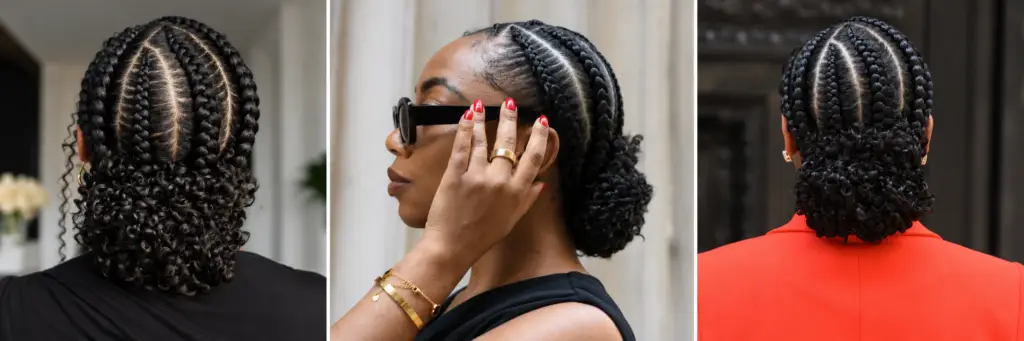
Braids, twists, locs, cornrows
The workweek athlete's answer. Rinse the scalp freely, dilute your cleanser in an applicator bottle, and dry thoroughly along the parts. Keep the install loose at the hairline.
High puff or low bun on stretched hair
Reads polished in an office, takes a workout without unraveling, re-forms with water and a smoothing pass. Move the tie's position daily.
Two-strand twists and twist-outs
Twist at night, wear out by day — the twists protect the hair through the workout and the take-down becomes the style. Sweat at the roots is the limit, not the ends.
Wash-and-go
Definition softens fast with sweat and humidity. Works if you are willing to re-wet and re-scrunch — a wash-day-adjacent commitment two or three times a week.
Wigs and units over cornrows
Convenient for the office, risky for the gym. Train in a scarf and install after if you can. Never re-cover a damp scalp.
Fresh silk press or blowout
Sweat reverts pressed hair, and re-pressing to fix it is where heat damage lives. If the week has a silk press in it, put the workouts before the appointment — not after.
By workout
Different sweat, different answer.
Running & cardio
The highest-sweat, highest-friction category, and the one that most rewards a braided or twisted base. Band at the hairline, hair up and off the neck, scalp rinse the same day. Outdoors, add sun protection — a cap over a satin lining, not directly on the hair.
Weights & strength
Low sweat, but watch the bench and the bar: lying down grinds the back of your head against vinyl and a barbell rests on the nape. Schedule this on freshly styled days — and wear the bun low, but not directly under the bar.
Hot yoga & sauna
Heat plus humidity equals total revert — plan for it rather than fighting it. Go in with hair already in its wet-state style, or accept that this session ends in a rinse. Never sit in a sauna with product-heavy hair covered up.
Swimming
Chlorine is the one case where prevention beats recovery. Saturate hair with water and conditioner before the cap goes on — wet hair cannot absorb as much pool water. Silicone cap over a satin one, and rinse and condition immediately after, every time.
Cycling & helmet sports
The helmet is a lid: sweat has nowhere to go and the straps sit on the same edges every ride. Use a satin liner or wrap underneath, keep sections flat so nothing bulks under the shell, and take the helmet off the second you stop.
Scalp watch
When it stops being a styling problem.
Most of this article is logistics. These four things are not — and the workweek habit of pushing through is exactly what turns them into something harder to reverse.
- Persistent itch or flaking that returns within a day of washing — often buildup or a scalp condition, not dryness.
- Tenderness or small bumps along the hairline after tying hair up — that is tension, and the fix is a looser tie today, not a stronger gel.
- Thinning at the temples or nape, or a hairline that has moved back. Traction alopecia is reversible early and not later; see a dermatologist.
- Breakage concentrated at one point on the shaft — your band, tie or helmet strap is sitting in the same place every session.
None of that is a reason to stop training. It is a reason to change the hardware and the placement, and to ask a professional before the pattern sets.
The questions underneath the question
Before you close this tab.
Should I wash my natural hair after every workout?
No. Most people with natural hair do not need shampoo after every session. Rinse or blot the scalp to remove salt, keep the roots dry and airy, and reserve a full cleanse for once or twice a week — or whenever the scalp itches or feels heavy with product.
What is the best hairstyle for the gym and the office?
Braids, twists, locs, and a stretched high puff or low bun. All four keep hair off the neck during a workout, survive multiple sweat sessions, and read as polished in a professional setting without restyling in between.
Does sweat damage natural hair or cause hair loss?
Sweat itself does not cause hair loss. The salt it leaves behind is drying, and sweat left sitting on a covered scalp can irritate it — but the loss people associate with working out usually traces to tight ties, repeated friction and daily manipulation, not the sweat.
How do I keep a silk press through a workout week?
Realistically, you don't. Sweat reverts pressed hair, and re-pressing to correct it is a common route to heat damage. Schedule the press after your heaviest training days, or wear a protective style during high-sweat weeks and save the press for a lighter one.
Is co-washing enough after sweating?
Usually yes, midweek. A cleansing conditioner removes salt and light buildup without stripping. If your scalp still feels coated, or you use heavy stylers and oils, a gentle sulfate-free shampoo on the scalp once a week clears what co-washing leaves.
Should I work out in a wig or a bonnet?
Prefer a moisture-wicking band or a scarf you can remove immediately. A wig traps heat and sweat against the scalp, and a bonnet worn over a damp scalp for hours invites odor and irritation. Air the scalp first, then cover it.
Your next step
Get a style installed that can carry the whole week.
The plan works best when the base style is right for your training load. The Chair List is our directory of stylists who install for real life — loose at the hairline, built to last five days of sweat.
Browse The Chair ListOver to you
Which day is your wash day — and what forced it there?
The grid above is a starting point, not a prescription. Tell us where it breaks for you — shift work, 5 a.m. training, a swim habit, a client-facing Friday — and we will build the variation in a follow-up. Leave it in the comments below.
General information only, not medical advice. For persistent scalp irritation or hair loss, consult a board-certified dermatologist.