

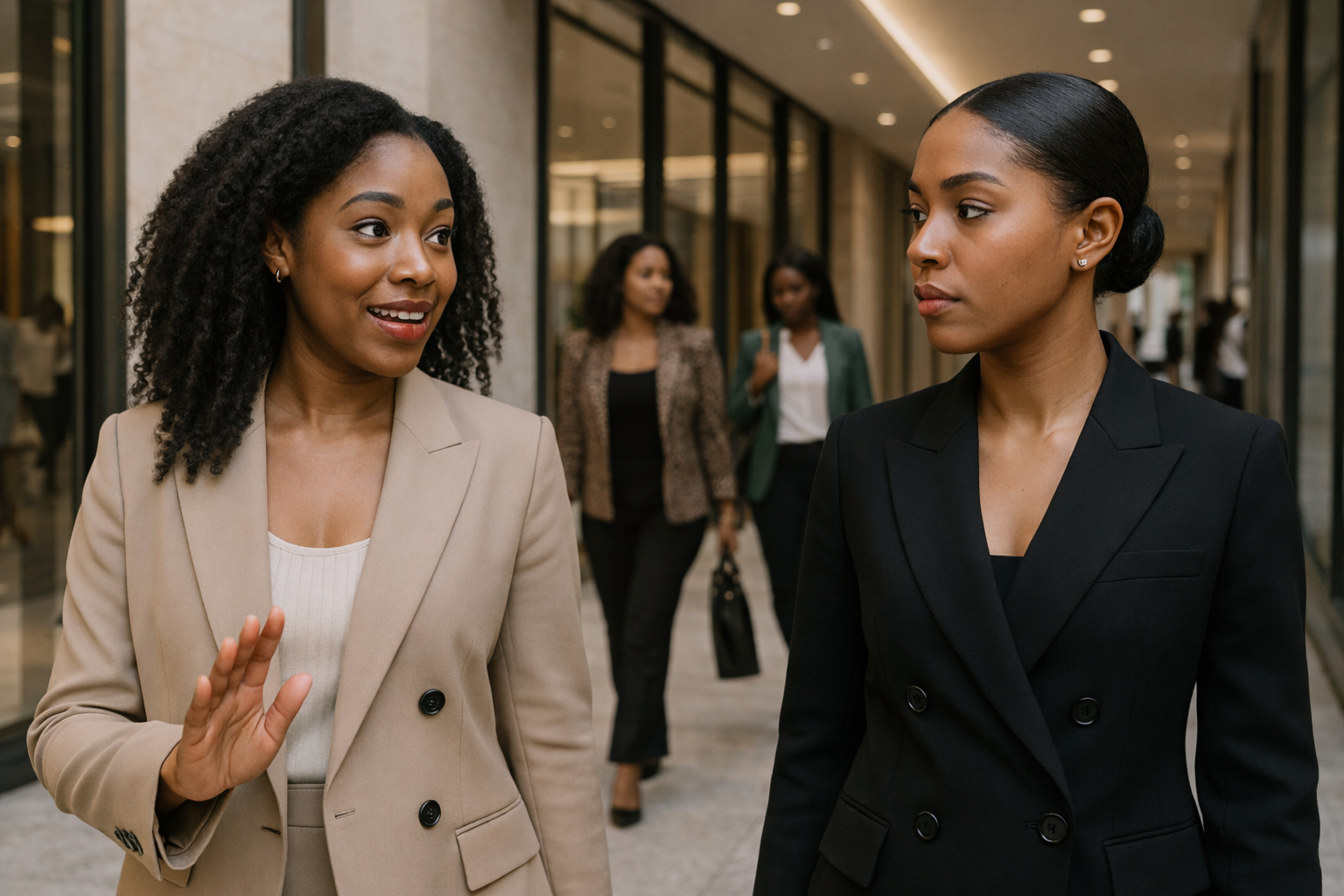
You Know That Look. That Moment. That Nod.
When you're walking down the hallway and spot another Black woman.
Even if you don't know her name, you know her.
You catch eyes. You nod. Sometimes it's a half-smile.
Sometimes it's the "hey girl" that doesn't even need to be said.
That moment? It's sacred.
It says, "I see you. I know what it took for you to be here. You're not alone."
And yet—every now and then—there's that one moment that knocks the wind out of you. When you catch eyes with another Black woman at work and… she doesn't nod back. Not just once, but consistently. She looks away. Walks past you. Barely acknowledges your presence.
The Competition Complex No One Asked For
Now let me say this clearly: this in most cases is the exception, not the rule. But when it happens? It stays with you. Because that unspoken sisterhood we tend to expect? It feels fractured.
So let's talk about it. Let's be clear—it's not just about a nod one day. Everyone has their days where they aren't feeling it. But have you ever had that experience at work, where it felt like another Black woman saw you as the threat?
Where you entered the room ready to connect, collaborate, and uplift—but were met with guarded energy? A cold shoulder? Passive-aggressive energy?
If you've been there, you're not crazy. You're not dramatic. You're not imagining things.
It's what we like to call the Competition Complex—and yes, it shows up in our own communities, too.
Have you ever experienced this at work—where it felt like another Black woman saw you as competition instead of community?
Share Your StoryThere's Not Room for Just One of Us
Somewhere along the way, a lie was planted: That there's only room for one.
One Black woman who gets the praise. One who's the "exception." One who fits. One who's chosen. One who makes it.
And if she already exists… where does that leave you?
It's a mindset shaped by scarcity, tokenism, and centuries of being pitted against one another in systems that were never built with us in mind.
But here's the kicker: Moving like that doesn't protect you. It isolates you. It reinforces the very system that created the scarcity in the first place.
Understanding the Root Causes
When companies only make space for one or two Black women in leadership, it creates artificial competition. We internalize the message that there's limited space at the table—so we start viewing each other as obstacles instead of allies.
For generations, systems have benefited from dividing us. From plantation hierarchies to modern workplace dynamics, there's a long history of pitting Black women against each other to maintain power structures.
When you've fought hard to get where you are, and you see how precarious it is, protection mode kicks in. Sometimes that protection looks like distance, guardedness, or yes—even competition.
Not every Black woman in corporate has had the same journey. Some of us code-switch. Some refuse. Some lean in. Some clock out. These different strategies can create friction when we expect solidarity based solely on shared identity.
Be honest with yourself: Have you ever caught yourself slipping into that mindset? Have you ever viewed another Black woman as competition before you saw her as community?
No Judgment Zone"When Black women build with each other, everybody wins. When we share what we know, we multiply power—not divide it."
The Magic When Black Women Link Up
Here's what's for sure: When Black women build with each other, everybody wins.
When we share what we know, we multiply power—not divide it.
When we stop side-eyeing and start strategizing together, we become unstoppable.
The real flex is community. Not competition.
How to Build Community if It's Uncomfortable
1. Lead with the Nod—Always
Even when you're tired. Even when you're stressed. Even when you're not sure if it'll be returned. Make eye contact. Acknowledge. Show up. Your consistency matters more than one person's response.
2. Create Space, Don't Just Take It
When you get in the room, bring someone with you. Share opportunities. Make introductions. Amplify other Black women's work publicly. Power hoarding protects nothing—power sharing multiplies everything.
3. Check Your Own Scarcity Mindset
When you feel threatened by another Black woman's success, pause. Ask yourself: Is this real competition, or is this internalized scarcity? Often, her win creates a pathway for yours—not a barrier to it.
4. Build Intentional Sisterhood Networks
Don't wait for organic connection. Schedule coffee chats. Start Slack channels. Create informal mentorship circles. Be deliberate about building relationships before you need them.
5. Extend Grace (To Them and to Yourself)
That woman who didn't nod back? She might be dealing with something you can't see. Extend grace. And when you're the one who can't muster the energy to connect? Extend grace to yourself too.
6. Name It When You See It
If you notice competitive dynamics in your workplace, address it. Have the conversation. "I've noticed some distance between us. Can we talk about it?" Silence perpetuates the problem.
Think of one Black woman in your workplace you haven't connected with. What's one small step you could take this week to build that bridge?
Commit BelowWhen You're on the Receiving End
If you've been met with coldness, dismissal, or outright hostility from another Black woman at work, here's what you need to know:
It's not about you.
Her behavior is a reflection of her experience, her wounds, her survival strategies—not your worthiness of connection.
Continue to show up with warmth. Continue to lead with community. Continue to build bridges.
And if after multiple attempts she still doesn't reciprocate? That's okay. Focus your energy on the women who do. There are plenty of us who want to link arms.
The Truth: Not every Black woman you meet will be your sister. And that's okay. But the ones who are? They're worth finding. They're worth investing in. They're worth fighting for.
The Real Flex Is Community
So the next time you walk down that hallway and lock eyes with a sister:
Lead with love. Lead with warmth. Lead with the nod.
And if she doesn't return it? That's her battle, not yours.
But just know—when Black women do link arms? Whew. Magic happens. Systems shift. Legacies are built.
What do you think drives the disconnect between Black women at work? And more importantly—how do we heal it?
Let's Heal Together





Yesss I’ve had this experience and experiencing it right now! This article is 🎯 yet very sad. I love people and naturally connect but the saved cannot look for validation in a lion’s den, in time learn the lesson, pass the test and elevate where your worth, talent and purpose will be valued.
It happens all the time. This article should be handed to every black woman in the workplace. It’s time for us to do some deep soul searching as to why we cannot support another black woman when we see her at work. I do think there are layers and complexities to it not explored here. We need to talk about this more. Now more than ever we need each other.