

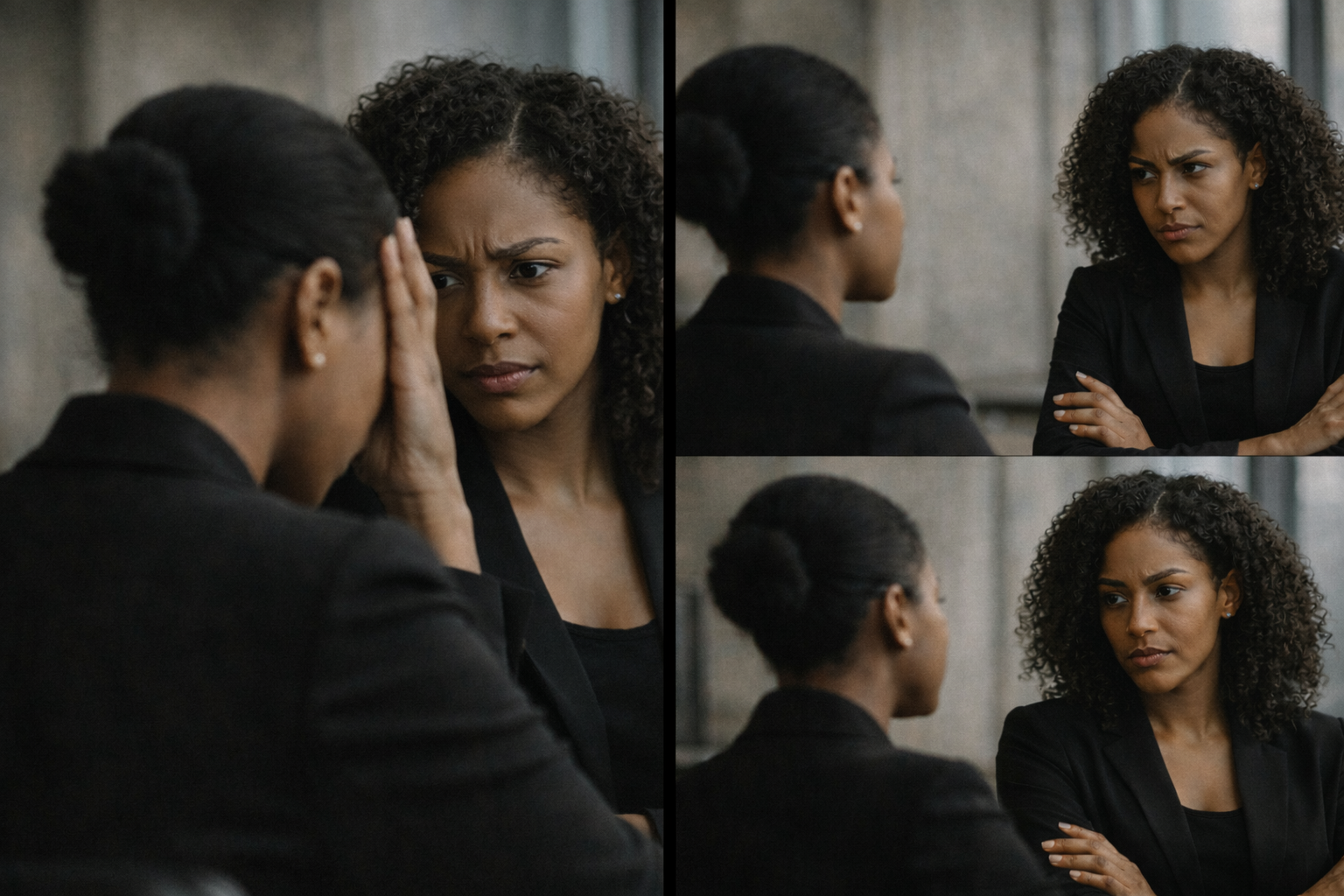
The Silent Sabotage: When Your Black Female Manager Isn't Safe Either
The Quiet Questions You Never Expected to Ask
There is a moment many Black women encounter in corporate life, one that often arrives quietly. You see that your new manager is a Black woman, and instinctively your body releases tension you didn't know you were holding.
Finally, someone who might understand. Someone who might recognize the weight you carry without needing translation.
Yet as the weeks go by, something shifts. The connection you anticipated feels inconsistent. She pulls close, then far. She praises you, then critiques you sharply. She feels warm one day and unreadable the next.
And without meaning to, you find yourself whispering silent questions:
The Unseen Story Behind Her Leadership
I once had a friend who worked for a Black woman who held authority with grace but beneath that grace lived pressure she could not name at the time. My friend expected ease. Alignment. Shared rhythm.
Instead, she walked into dynamics that felt unpredictable. It reminded her of watching a movie where the main character slowly realizes that the tension is not coming from outside the house at all. It's coming from someone standing in the same hallway someone battling a threat you cannot see.
The Reframe
She was not the villain. She was not her competitor. She was surviving a system that required her to bend in ways that were never required of others who didn't look like her.
Why Her Position Is Not the Safety Net You Imagined
Black women in leadership often exist inside a pressure cooker. Their competence is questioned more. Their decisions are scrutinized faster. Their credibility is more fragile in the eyes of the room.
She carries all of this before she ever sits down at her desk each morning.
So when you step into her orbit with ambition and potential, she sees both promise and risk. Not because she doubts you. But because she knows how the room might interpret your brilliance.
She wants you to succeed but she also needs to preserve her own footing. And those two desires do not always move in harmony.
Understanding the Dynamic
What It Feels Like
- Her protectiveness feels like policing
- Her caution feels like distance
- Her stress feels like sabotage
- Her silence feels like betrayal
- Her criticism feels personal
What It Might Actually Be
- Fear of being seen as "favoring" you
- Self-preservation in a hostile environment
- Transferred pressure from her own leadership
- Uncertainty about how to advocate safely
- Projection of standards she's held to
The Scarcity That Shapes Her Decisions
When you are one of the only Black women in leadership, scarcity becomes its own kind of pressure.
She might feel that helping you shine puts her in shadow. She might feel that advocating for you too loudly risks accusations of favoritism. She might believe there is space for only one of you to move freely.
Hard Truth
This scarcity is not natural. It is manufactured. But it still shapes her behavior.
You hoped for mentorship. She hopes for stability. Both of you are navigating a system that benefits from your distance.
The Silence That Hurts More Than Words
The hardest part is often not what she says. It is what she does not say.
- The advocacy that never happens
- The context she withholds
- The moments she chooses the room over you
It stings because you expected her to see you. It cuts because you believed she could shield you. It disappoints because you assumed safety where she had none to offer.
The Reality You Were Never Prepared For
Black women do not always get to lead freely. They lead while being watched. They lead while being doubted. They lead while being asked to represent more than themselves.
What She Is—And What She Isn't
Your antagonist. The person blocking your path. Someone who wants to see you fail.
Your savior. The one who will always protect you. Someone who can fix the system for you.
A woman trying to survive a system that was not built for her leadership—or your growth—to coexist comfortably.
Once you understand that, the dynamic stops feeling personal and starts feeling structural.
How to Navigate This Dynamic with Clarity and Care
Understanding what's happening doesn't mean accepting harm. Here's how to protect your growth while holding space for the complexity:
Study the environment before studying yourself
Observe patterns in meetings, communication, and pressure points. Is she acting from fear, pressure, or rivalry? Understanding the room helps you understand the behaviors.
Keep your work documented and visible
Your impact should never be a negotiation. Make sure your wins have a place to live that does not rely on someone else's memory—or willingness to speak.
Seek mentorship outside the reporting line
You deserve guidance unfiltered by internal politics. Your manager cannot be your only source of support, development, or advocacy.
Redefine what solidarity means in this context
Support might not come in the form you imagined. Allow yourself to adjust your expectations without absorbing disappointment as failure.
Create healthy emotional boundaries
You can respect her humanity without tying your self-worth to her leadership style. She is part of your journey, not the author of it.
Build pathways that don't depend on her readiness
Your career momentum should not rest on someone else's limitations. Build connections, relationships, and credibility that expand your options independently.
Hold compassion if you can—but protect yourself first
Her struggle deserves empathy. Your trajectory deserves protection. Both can coexist. But your peace comes first.
Related Reading
When The Nod Isn't ReturnedExploring the quiet harm that happens when Black women pass each other in professional spaces without acknowledgment—and how that silence erodes connection and belonging.
The Bottom Line
The relationship between Black women across corporate hierarchies is layered, complex, and shaped by forces neither of you created. She is not your enemy. But she may not be your safe harbor either.
Your job is not to save her, fix her, or wait for her to show up the way you hoped. Your job is to understand the terrain, protect your growth, and build a career that doesn't depend on anyone else's readiness to champion you.
Final Truth: You can hold compassion for her struggle and still choose yourself. Those two things were never in conflict.
For more conversations on workplace dynamics, identity, and navigating corporate spaces as a Black woman, visit our blog for weekly insights.
Want to process experiences like this with other women who get it? Join The Corporate Clock Out.









I’ve been both the “boss” and the employee. I’ve had to protect another’s incompetence/juvenile behavior while trying to present my leadership abilities. The problem was, my Black employee freely spoke to my non-Black supervisor about me, while I was trying to protect her. Now, I report to a Black woman (while I have fewer supervisory responsibilities). Because I know what it feels like, I do my best to not put her in positions I was put in constantly. I do talk with her, but always as my supervisor– never as my friend.
It’s genuinely wild when we don’t just get the code of supporting one another. Kudos to you on attempting to maintain the peace!